Burnout is not always easy to recognize, especially when you are still functioning well.
Many of the women I work with are successful, responsible, and deeply capable. They manage careers, relationships, children, households, aging parents, friendships, appointments, and an endless number of details other people may never even realize they are carrying. They are often the person others turn to when something needs to get done.
From the outside, they may look anything but burned out.
That is part of what can make burnout in high-functioning women so difficult to recognize. We tend to associate burnout with an inability to function: missing work, falling behind, withdrawing from responsibilities, or reaching an obvious breaking point. But some women continue functioning at an extremely high level even as their emotional and physical resources are becoming depleted.
For women who chronically overfunction, some of the earliest signs of burnout may have less to do with what they stop accomplishing and more to do with how much of themselves they are using to keep accomplishing it.
When You Become Responsible for Keeping the Story Moving
In therapy, I sometimes ask clients whether they feel like the main character in their own story.
With women who chronically overfunction, however, I often notice something slightly different. They aren’t necessarily describing themselves as a supporting character.
Sometimes they seem to occupy the role of the person responsible for writing the entire book.
They are keeping track of the plot. They anticipate what everyone needs, notice changes in other people’s moods, remember what needs to happen next, and think several steps ahead about what could go wrong. At home, at work, and in relationships, they often become the person responsible for keeping things moving.
That orientation toward other people can become remarkably automatic.
I may ask a client how she experienced a difficult interaction, and she responds by explaining why her husband reacted the way he did. I may ask how she is feeling, and she tells me what is happening with her children. I may ask about something she accomplished, and within moments we are discussing everything that still needs to get done.
Sometimes I will gently point this out:
Often, the response is a pause and genuine surprise.
She wasn’t necessarily trying to avoid the question. She simply didn’t notice that she hadn’t answered it.
That distinction is important. Chronic overfunctioning isn’t always a conscious decision to ignore yourself or put everyone else first. Sometimes attending to everyone else’s needs has become such a practiced way of moving through the world that identifying your own experience requires deliberate effort.
You may be extremely skilled at noticing the emotional temperature of everyone around you while having a much harder time answering seemingly simple questions such as: What am I feeling? What do I need? What do I want?
Over time, that constant outward focus can contribute to burnout because your own needs are repeatedly identified later, if they are identified at all.
Accomplishments Start to Feel Like Expectations
Another pattern I notice is the way some high-functioning women experience achievement.
It would be easy to call this “minimizing accomplishments,” but I don’t think that always captures what is happening.
Sometimes the accomplishment never gets registered as an accomplishment in the first place.
You managed an incredibly difficult season at work. You handled a family crisis. You earned the promotion. You kept everything functioning while someone you loved was struggling. You navigated a major transition. You solved the problem everyone else was overwhelmed by.
And instead of experiencing pride or satisfaction, the internal response is something closer to:
Of course I did. That’s what I was supposed to do.
There can be an invisible standard operating in the background, an expectation that competence is simply the baseline.
Where that expectation came from will be different for every woman. Family roles, childhood experiences, workplace expectations, gender expectations, perfectionism, and years of being identified as “the responsible one” can all contribute. Often there isn’t one obvious source.
The important part is what happens once the standard becomes internalized.
Meeting it doesn’t necessarily feel successful. Meeting it simply means you did what was expected.
There may be little opportunity to pause and think, That was hard. I handled that well. I’m proud of myself.
Instead, attention shifts almost immediately to the next responsibility.
That can create an exhausting psychological system: doing exceptionally well provides very little sense of accomplishment, while falling short of your own expectations can feel deeply uncomfortable.
“I Can’t Do Everything” Doesn’t Feel Like an Option
Eventually, every person reaches a limit. There are only so many hours in a day and only so much emotional, cognitive, and physical energy available.
For someone accustomed to overfunctioning, however, reducing the demands may not feel like the obvious solution when that limit is reached.
Instead, she finds another way to make everything fit.
The work deadline stays. The children’s needs stay. The household responsibilities stay. The person who needs help stays. The appointment stays. The obligation stays.
Something still has to give.
And very often, what becomes negotiable is something that would have benefited her.
- The workout disappears.
- The therapy appointment gets canceled.
- Lunch happens at the desk, or doesn’t happen at all.
- Sleep gets shortened.
- The doctor’s appointment gets postponed again.
- Time with friends becomes difficult to justify.
- The quiet hour she wanted gets filled with one more task.
This can happen gradually enough that it doesn’t initially look like a crisis. In fact, from the outside, the system may continue working beautifully.
The cost is simply being absorbed by one person.
When Something Has to Give, Notice How Often the Thing That Gives Is You
This is one of the reasons burnout can develop without an obvious moment when everything falls apart.
Sometimes nothing falls apart.
You keep making adjustments that allow everything else to remain intact.
The problem is that many of those adjustments remove the very things that help restore your physical and emotional resources. Sleep, movement, therapy, medical care, relationships, recreation, solitude, and genuine downtime become optional while responsibilities remain mandatory.
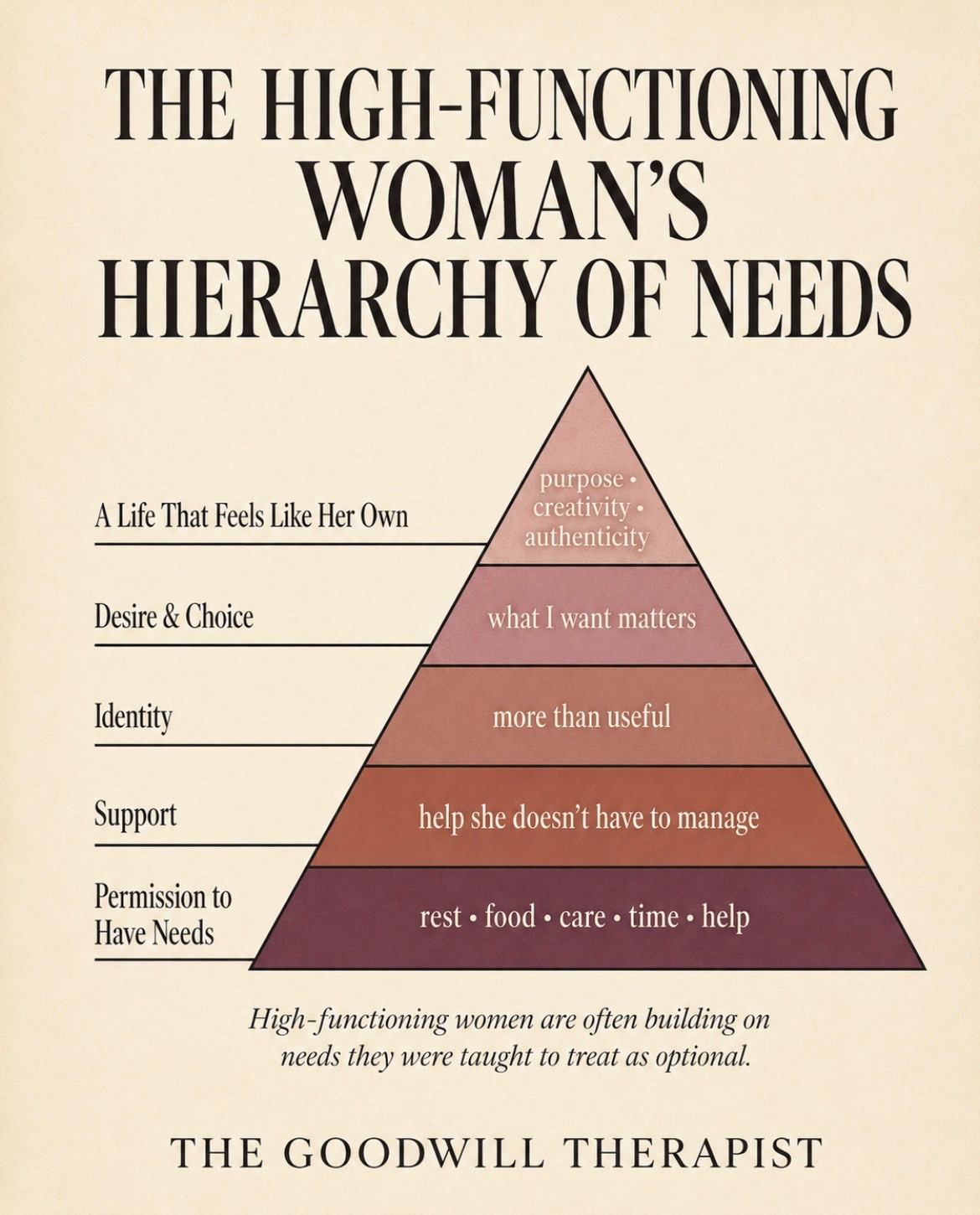
Over time, the consequences may begin appearing in more recognizable ways.
You may feel exhausted even after resting. Concentration may become more difficult. Your patience may get shorter. Small requests can begin to feel disproportionately irritating or overwhelming. You may notice resentment toward people you genuinely love. Activities that used to feel enjoyable may start to feel like additional obligations.
You may also find yourself thinking more frequently about wanting everyone to simply stop needing something from you.
These experiences can accompany burnout, but they aren’t evidence of a personal failure or an inability to “handle stress.” They can be signals that the way you’ve been maintaining your life is requiring more from you than you can sustainably provide.
The question isn’t simply whether you are still capable of doing everything.
The more useful question may be whether the way you are doing everything is sustainable.
Why Rest May Not Feel Like Enough
A common response to burnout is to recommend rest, and rest certainly matters.
But for chronically overfunctioning women, “just rest” can miss an important part of the problem.
If you have spent years orienting yourself toward what needs to happen next, sitting down doesn’t automatically turn that orientation off. Your body may be on the couch while your mind continues scanning the environment for unfinished tasks, upcoming problems, or someone else’s needs.
Rest can even create discomfort.
You may feel guilty because something could be getting done. You may reach for your phone. You may start mentally organizing tomorrow. You may decide this would be a good opportunity to catch up on something.
In other words, you technically stopped working without necessarily experiencing restoration.
This is why recovering from burnout may involve more than creating additional downtime. It can also require understanding the patterns that made your own needs so consistently negotiable in the first place.
Recognizing Burnout Before Everything Falls Apart
You do not need to wait until you can no longer function to take burnout seriously.
In fact, if you are accustomed to functioning at a high level, your ability to continue performing may be one of the reasons burnout goes unnoticed for so long.
Rather than asking only, “Am I still getting everything done?” consider asking:
What is it costing me to keep getting everything done?
Notice what happens when someone asks how you are doing. Can you answer without immediately talking about someone else?
Notice what happens when you accomplish something difficult. Can you recognize it as an achievement, or does it simply feel like another expectation met?
Notice what happens when your schedule exceeds your capacity. What gets removed first?
And perhaps most importantly: when something has to give, notice how often the thing that gives is you.
Therapy for Burnout and Overfunctioning in Phoenix
Therapy doesn’t have to begin with immediately changing every responsibility, setting a dozen new boundaries, or adding “self-care” to an already overwhelming to-do list.
Sometimes the first meaningful step is simply noticing a pattern that has become so automatic you no longer realize it is happening.
For high-functioning women, that might mean learning to recognize your own emotional experience alongside everyone else’s. It might mean examining the expectations you’ve been meeting without ever deciding whether they are reasonable. It may involve understanding why asking for help, disappointing someone, resting, or allowing something to remain unfinished feels so uncomfortable.
The goal isn’t to stop being helpful or dependable. It’s to explore whether those qualities can exist without requiring you to continually disappear in order to sustain them.
At Kind Counseling Collective, I provide individual therapy in Phoenix and online throughout Arizona for women navigating burnout, anxiety, overfunctioning, perfectionism, trauma, and major life transitions.